
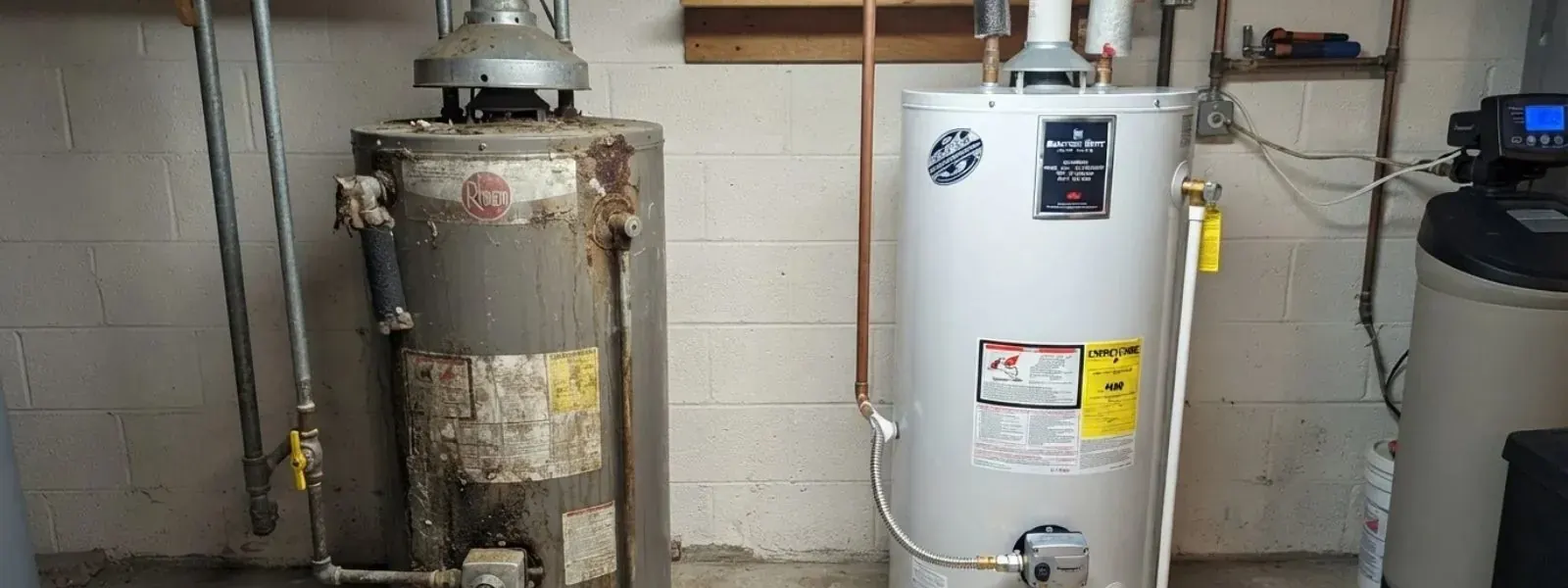
What decides how long a tank lasts
There is no fixed lifespan. A tank heater commonly serves for roughly a decade, sometimes longer, and some fail earlier. The steel tank is protected inside by a glass lining and a sacrificial anode rod. Once the rod is consumed, corrosion attacks the tank itself. Water chemistry, sediment, temperature setting and maintenance all change the timeline.
Tankless units often last longer when flushed regularly, but they have their own failure points. Our tankless water heater service page covers those.
Warning signs that a tank is near the end
| Sign | What it suggests | Action |
|---|---|---|
| Rusty hot water. | Corroding tank or anode. | Inspect, plan replacement. |
| Rumbling or popping. | Sediment buildup. | Flush, evaluate age. |
| Moisture or drips at the base. | Tank leak or fitting. | Shut off and call. A leaking tank cannot be repaired. |
| Not enough hot water. | Failed element, burner or sediment. | Diagnose. |
| Age beyond ten years. | General wear. | Plan ahead. |
Water on the floor around the tank is the sign that decides everything. Close the cold supply, shut off power or gas and call. See water heater replacement for emergency swaps.
Maintenance that adds years
- Flush a few quarts from the drain valve once a year to move sediment.
- Check the temperature and pressure relief valve by lifting the lever briefly, with a bucket ready.
- Inspect the anode rod every few years and replace it when worn.
- Keep the area around the heater clear.
- Install a drain pan with a line to a drain if the heater sits above living space.
Anode rods are cheap compared with a tank. Replacing one on time is the best-value maintenance task.
Water quality and your tank
Hard or mineral-heavy water builds scale faster and shortens life. Soft or aggressive water can eat anode rods quickly. Because Grafton homes draw from different sources, results vary even on the same street. Ask your water district for its annual report or test your tap. If minerals are high, flushing more often helps.
Setting the thermostat very high speeds scale and raises scald risk. A moderate setting is easier on the tank and safer.
Replace on your terms
Replacing before failure lets you choose the unit, compare tank, tankless and heat pump options and schedule a time that suits you. Our water heater installation page covers the planned route. A tank that fails at night costs more in damage and stress than a planned swap.
Tank, tankless or heat pump when it is time
A tank is the lowest upfront cost and the simplest swap. Tankless units take less space and do not run out, but they need venting and gas capacity, and scale management. Heat pump water heaters use much less electricity but need room, air and a drain for condensate. The best choice depends on your fuel, your space and how you use hot water, and we lay out the trade-offs for each without pushing a brand.
Rebates and incentives for efficient units change from time to time. Check current program pages before you buy so you do not miss a program that applies to you.
Know your shutoff before you need it
Find the cold water shutoff on top of the tank and the gas valve or breaker. If the tank leaks, close the cold supply first, then shut off power or gas. Having done it once in a calm moment makes it easy on a bad night.
Reading the label
The data plate on the tank holds the serial number, capacity and rating. Many serial numbers encode the month and year of manufacture, and the maker can decode it. Write the date on the tank with a marker and keep the paperwork. That way, you will know the age even when the house changes hands.
Hot water safety
Set the thermostat to a safe moderate temperature, especially with children or older adults at home. Check the relief valve once a year. If it drips, if the tank rumbles or if you see water around the base, have it checked. A neglected relief valve is a safety device that has stopped doing its job.
Keep paperwork and a spare plan
Store the manual, the receipt and the installer details in one folder. Decide in advance who you will call and what unit you would choose. A written plan makes a failure on a holiday weekend far less stressful, and you can act the moment you see rust or a puddle.
Gas, electric and what each tank fails from
Gas tanks fail from corrosion at the base and from burner problems. Electric tanks lose heating elements and thermostats often before the tank itself. Elements are cheap to replace, so an electric tank with a bad element may have many years left.
Ask the plumber what failed. A worn element or thermostat is a repair. A leaking tank is a replacement. Knowing the difference keeps you from replacing a heater that only needed a small part, and from repairing one that is past saving.
Vacation and seasonal homes
Water heaters in seasonal homes sit idle and can corrode or leak unseen. Shut off the supply and drain the tank when you close the house for the winter. Inspect it when you return. A short checklist protects a home you are not there to watch.
Insurance and old heaters
Some insurers ask about the age of the water heater or limit coverage for old units. A newer heater with a drain pan can lower risk. Ask your carrier what they expect, and keep the receipt for any replacement.
Water heaters and Grafton rules
Water heater work in Massachusetts is governed by the state plumbing and gas code, 248 CMR 10.00, and performed by licensed plumbers or gas fitters. Verify a license with the state Board of State Examiners of Plumbers and Gas Fitters lookup. Ask the Grafton building department what permit applies to a replacement.
Grafton homes get water from the Grafton Water District, the South Grafton Water District or private wells. Request the annual water quality report from your district, or test a private well, before deciding how often to flush and when to inspect the anode.
Common questions
How do I find the age of my water heater?
Check the serial number on the label. The manufacturer can decode the date.
Can a leaking water heater tank be repaired?
No. A leaking tank is replaced.
Should I flush my water heater?
Yearly flushing helps move sediment, especially with mineral-rich water.
What does the anode rod do?
It corrodes in place of the tank steel. Replace it when it is mostly consumed.
How do I learn about the water in my Grafton home?
Ask your water district for its annual water quality report. Private well owners should use a lab test.